How colour calibration works
For a numbered walk-through on real data, with the settings and troubleshooting, see Tutorial 9: Photometric colour calibration.
A colour camera's red, green and blue do not see the sky the way a viewer
expects, and the balance of a stack depends on the sensor, the filter and the
sky. The stars say what the balance should be: Gaia measured a colour (BP-RP)
for every bright star. Photometric colour calibration measures the stars in the
picture in each colour, compares them with Gaia, and sets the white balance so
that stars come out the colour they really are. The code is
valerian_core::photocal; the command is valerian photocal.
The method
- Stars. The plate solution (the image's WCS, from plate solving) places the Gaia stars in the frame. Stars of G 6 to 11 with a BP-RP of 0.3 to 2.5 are used by default: brighter ones saturate, and the colour of very red stars is not a straight line. Each is tied to a star detected in the image (within 3 pixels), and a star with another detected star in or near its aperture is dropped.
- Photometry. Every star is measured in red, green and blue through the same circular aperture, twice the median FWHM in radius, with the sky taken from a clipped median of an annulus around it. Stars with a signal-to-noise under 15 in any colour, or a non-positive flux, are dropped.
- Fit. For red and for blue,
-2.5 log10(F / F_green)is fitted against BP-RP as a straight line. The fit starts from the Theil-Sen line (the median of the pairwise slopes), which a few wild stars cannot move, and is then refined by least squares with 3-sigma clipping. A star that is off in either colour is dropped from both. - Balance. The reference colour, BP-RP 0.82 (a G2V star like the Sun), is set as neutral: each channel's gain makes the line's value at that colour equal to green's. Green's gain is 1, so the brightness of the picture stays where it was.
- Background. The sky level of each plane, after the gain, is brought to the mean of the three, so the background is neutral grey and the light pollution does not tint the picture.
The two slopes are the camera's colour response, and double as a check: red must brighten against green as BP-RP rises, and blue must dim. If either has the wrong sign a warning says the planes may not be red, green, blue in that order, or the image is not linear.
Do it on the linear image, after background extraction and before stretching: the colour of a star is a ratio of fluxes, and a stretch breaks that. A stretched image is refused.
On the command line
valerian solve stack.fits -o solved.fits
valerian photocal solved.fits -o balanced.fits
The input is never changed. Without -o the result is only printed:
36 Gaia stars measured, 33 used; aperture radius 5.1 px; neutral at BP-RP 0.82
  red against green: slope -0.635 mag per BP-RP, scatter 0.027 mag, gain 0.7547 +/- 0.0032
 blue against green: slope +0.080 mag per BP-RP, scatter 0.024 mag, gain 0.9860 +/- 0.0037
sky before 610.73 597.25 608.32, after 552.64 552.64 552.64 (offsets -91.74 44.61 47.13)
The gains and offsets go into the header as PCCGAINR, PCCGAING,
PCCGAINB and PCCOFFR, PCCOFFG, PCCOFFB, with a HISTORY line. An image
with no WCS is solved first from the header's position and scale; give
--wcs other.fits to take the solution from another file (a solved copy made
earlier, say). --reference-colour moves the neutral point (a bluer value gives
a warmer picture), --min-mag, --max-mag, --colour-min, --colour-max,
--aperture, --min-snr and --min-stars change the star selection,
--no-neutralise leaves the sky levels alone, and --stars-out writes every
star measured to a CSV file.
In the desktop app
Open an image, choose Colour, and press Calibrate colour. The image needs three planes and a plate solution, either its own or the one the Plate solve tool found.
The panel shows the gains, the slopes and the scatter, and the stars used are circled in the viewer. Calibrated and Original switch the picture, and Save calibrated writes the full-size result.
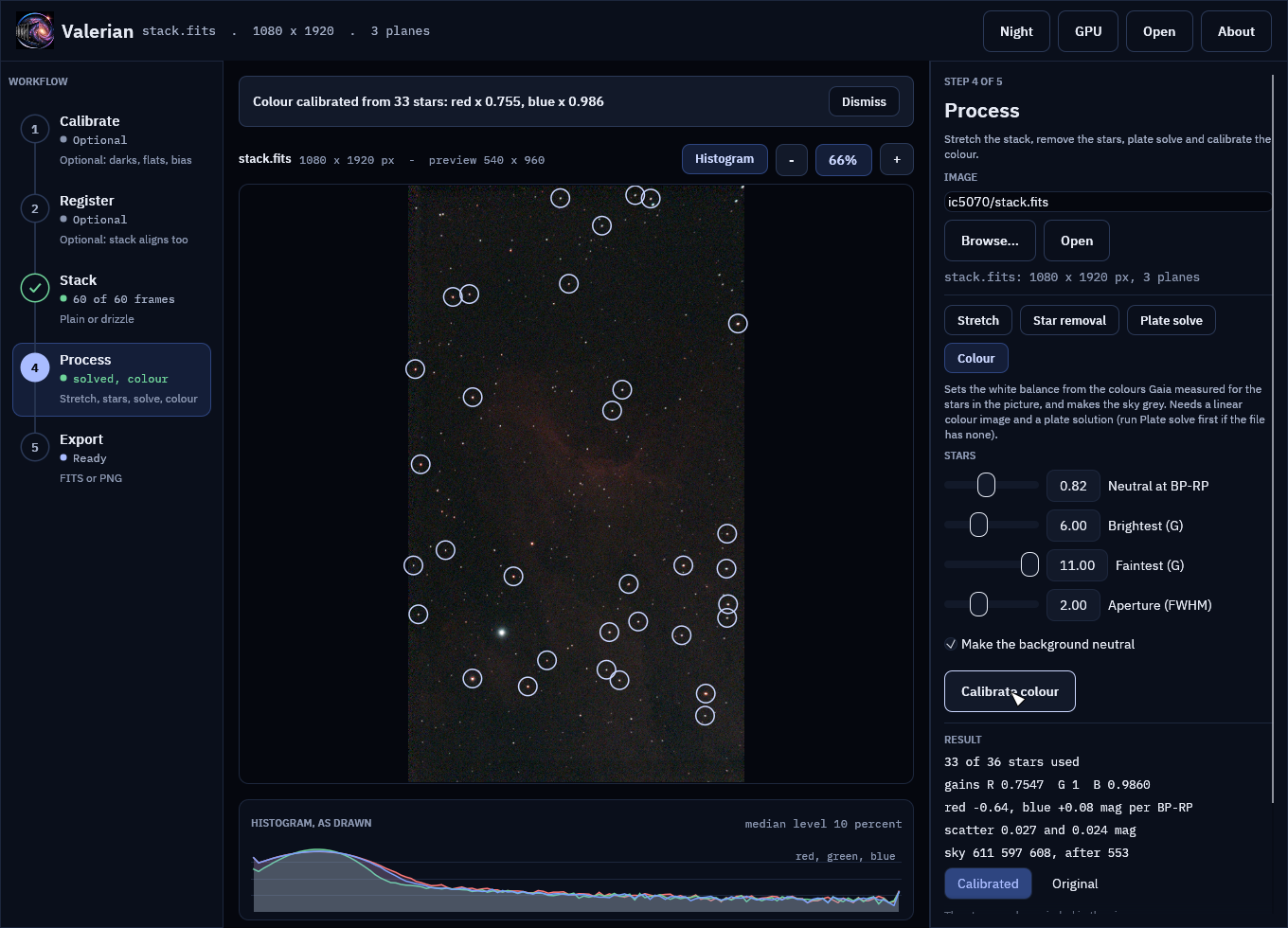
Original in the panel shows the picture before the calibration, for comparison.
The screenshots are of a synthetic field (valerian_core::testutil::colour_scene)
whose red and blue are out of balance by a known amount, because image data is
never committed.
The catalogue
The colours come from the catalogue file. Version 2 of the format (written by
scripts/build_catalogue.py since this feature) adds a BP-RP byte to every
star; a version 1 file still solves but has no colours, so it cannot calibrate.
gaia-dr3-g11.vcat carries 1,247,240 stars to G = 11, 10.0 MB, under the same
licence as before, CC BY-SA 3.0 IGO (Gaia DR3, ESA/Gaia/DPAC).
Measured
On the Seestar S50 stack of IC 5070 (10 s subs, 60 stacked, a light-pollution
filter, 1080 by 1920), 36 Gaia stars are measured and 33 kept, in 0.3 s. Red
needs a gain of 0.755 and blue 0.986. scripts/compare_python_photocal.py repeats
the measurement with different code: the WCS read by astropy, Gaia fetched from
the archive to G = 13, stars centred by centre of mass and the FWHM measured by
a Gaussian fit, photutils aperture and annulus photometry, and an outlier-clipped
fit.
| Stars | Count | astropy and photutils gain (R, B) | Valerian gain (R, B) |
|---|---|---|---|
| The same, G < 11 | 34 | 0.7583, 0.9850 | 0.7547, 0.9860 |
| Deeper, G < 13 | 143 | 0.7465, 0.9771 | 0.7547, 0.9860 |
The gains agree to 0.5 % on the same stars and to 1.1 % with the deeper set, which is about the scatter of the fit. Measured the same way, the calibrated image's line value at BP-RP 0.82 is +0.004 mag in red and -0.001 mag in blue (0 is neutral), and the sky medians of the three planes agree to 0.05 ADU (552.59, 552.63, 552.64).
Synthetic fields with known gains check the recovery to 3 %, that a calibrated image calibrates to gains of 1, that the neutral point moves the balance the right way, that planes in the wrong order are warned about, and that stars with the wrong colour are rejected.
What it cannot do
- It needs a plate solution and enough stars (15 by default) of G < 11 in the field; a narrow field wants a deeper catalogue.
- The line is straight in BP-RP, which holds over ordinary stars. Emission nebulae have no star colour and do not enter the fit, so a nebula's colours are whatever the balance makes them.
- Gaia's colours include interstellar reddening, which is what the camera sees too; the balance is of the light as it arrives, not corrected for dust.
- It does not know the sensor's spectral response beyond the two slopes it measures, and a narrow-band or dual-band filter makes the slopes small. The Seestar's light-pollution filter gives a blue slope of only +0.08.