How star removal works
For a numbered walk-through on real data, with the settings and troubleshooting, see Tutorial 7: Star removal.
Star removal splits an image into two: the sky and nebulosity without stars
(the starless image) and the stars on their own (the star layer). Stretch
and colour-grade the nebula hard without the stars blooming, then add the stars
back. Valerian does this with a classical method and no learned model. A
learned model may be offered one day as an option; it would be labelled, and it
would never be the default. The code is valerian_core::starless; the command
is valerian starless.
The method
- Detect. Stars are found on the luminance with the same detector registration uses, with a lower threshold (4 sigma of the smoothed noise) and no limit on how many.
- Mask. Each star gets a disc. Its radius is where a Moffat profile with the
star's own width and peak falls to half the pixel noise. A Moffat profile is
used, not a Gaussian, because the wings of a real star are heavier than a
Gaussian's. The radius is then scaled (
--mask-scale), grown (--growpixels), kept at no less than two FWHM and at most--max-radius. The mask is the union of the discs. All colour planes share one mask. - Fill. Inside each connected piece of the mask every plane is filled by solving Laplace's equation with the unmasked pixels around the piece held fixed: harmonic, or diffusion, inpainting, solved by successive over-relaxation. The fill meets its surroundings without a seam and follows a gradient through the hole. Pieces are independent and run in parallel.
- Noise. A diffusion fill is smooth, and a smooth patch in a noisy sky is
easy to see. Unless
--no-noiseis given, Gaussian noise of the level measured on the unmasked pixels beside each piece is added inside it. The noise is seeded (--seed), so a run is repeatable.
Pixels outside the mask are not touched: they are bit for bit what they were.
On the command line
valerian starless stack.fits -o starless.fits --stars-out stars.fits
valerian starless stack.fits --preview look.png
--stars-out writes what was removed: stars = original - starless, exactly,
so the two layers add back to the original. --mask-out writes the mask.
--preview writes a PNG of the original and the starless image side by side,
both on the automatic stretch of the original, and with it -o is optional.
--strength below 1 removes only that fraction of every star, which reduces them
instead: 0.5 leaves each star at half its brightness. The star layer then holds
the other half.
In the desktop app
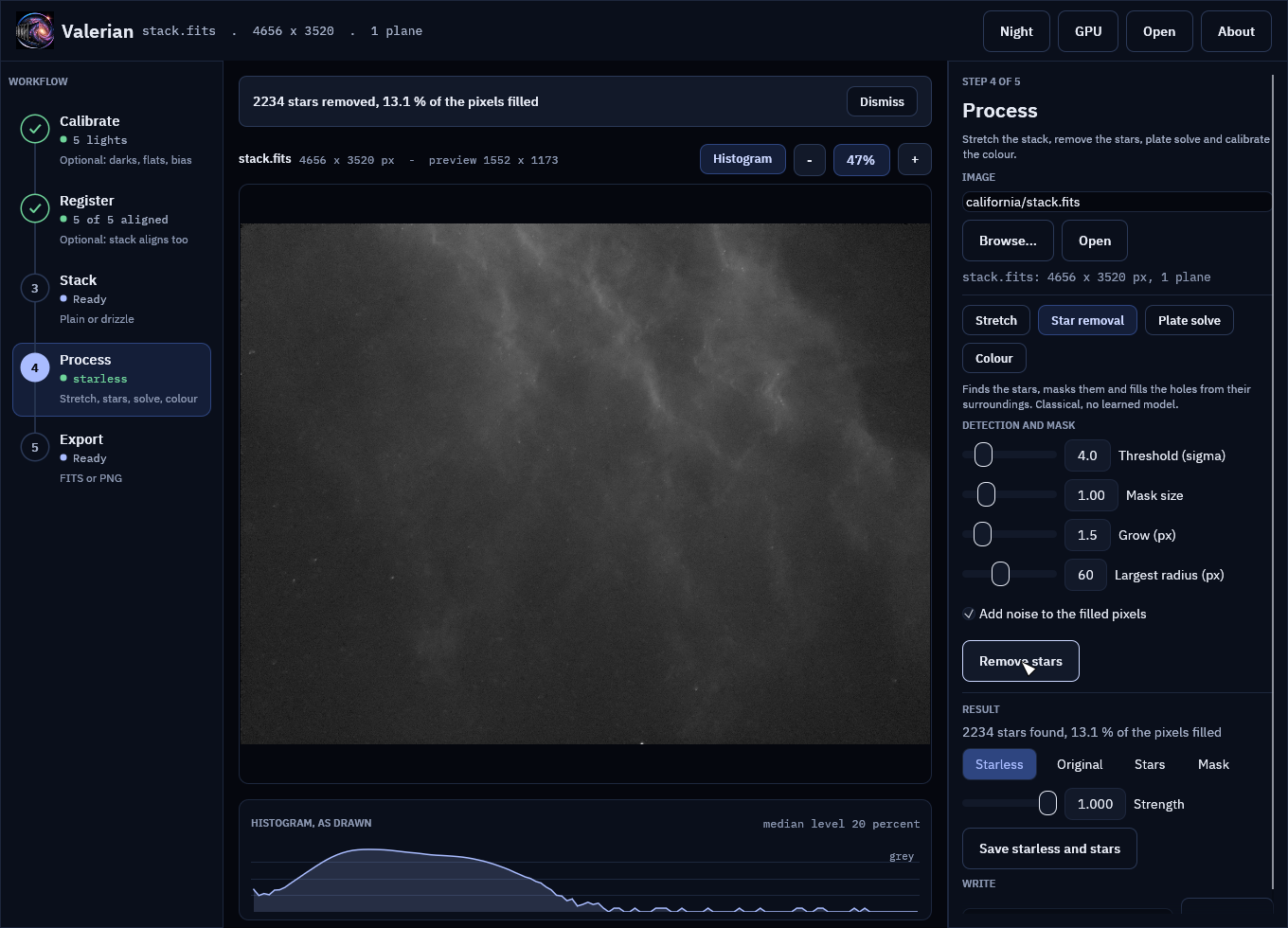
Open an image, choose Star removal in the Process step and press Remove stars. The detection and fill run on the full image in the background, because the detector needs the real pixel scale; the window stays usable.
When the run finishes the viewer shows the starless image, and the panel offers the other layers: Original, Stars (the star layer on the sky level) and Mask. The views share one automatic stretch, so they can be compared.
The same on the colour stack of IC 5070:
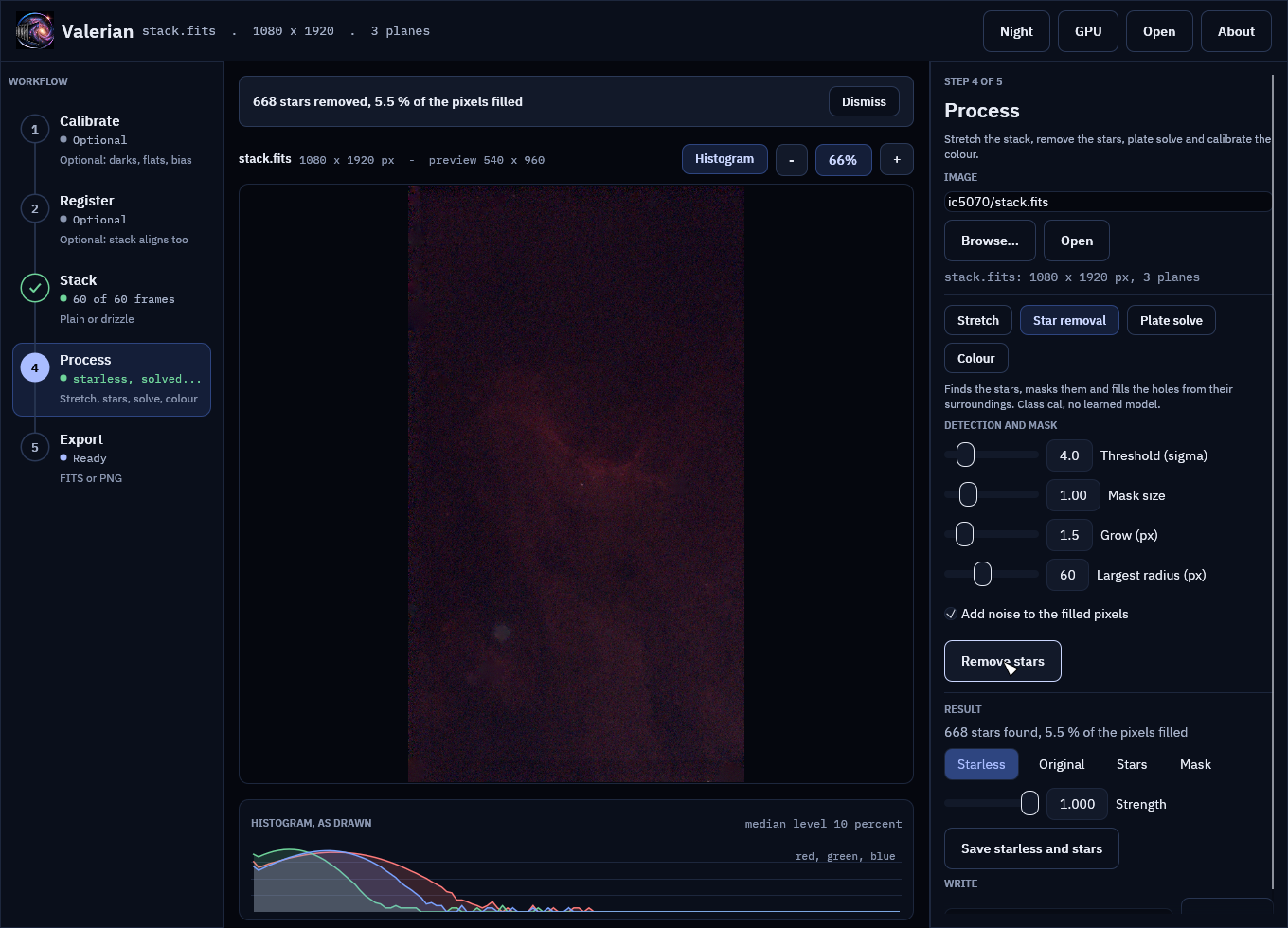
The Strength slider is applied after the run (original - strength * stars),
so moving it costs nothing and needs no new run. Save starless and stars
writes both layers as FITS files, by default <name>_starless.fits and
<name>_stars.fits next to the original.
The screenshots are of the real stacks of a first session.
Settings
| Option | What it does |
|---|---|
--threshold | Detection limit in sigmas of the smoothed noise. Lower finds fainter stars and fills more of the frame. |
--mask-scale | Multiplies every mask radius. Raise it if a bright star leaves a faint disc of halo. |
--grow | Pixels added to every radius. |
--max-radius | The largest disc. A cap keeps one saturated star from filling a quarter of the frame. |
--no-noise | Leave the smooth fill. |
--strength | Fraction of each star to remove. |
Measured
On stacked data on a 24-core machine (release build): the 4656 by 3520 H-alpha stack from the ASI1600MM (the five-minute frames of the stacking tests) finds 3279 stars, fills 13.8 % of the pixels and takes 4.3 seconds; a 1080 by 1920 Seestar colour stack (three planes) finds 668 stars, fills 5.5 % and takes 0.9 seconds. On a synthetic frame with known truth the fill inside the mask is on average within 12 ADU of the true starless frame (the noise is 6 ADU), and over 92 % of the star light is gone (the tests check both).
What it cannot do
- It does not recreate texture that a star hides. A bright star on a nebula leaves a smooth patch the size of its mask, with noise added but no structure.
- Diffraction spikes and halos beyond the mask stay. A very bright star can leave
a faint disc; a larger
--mask-scaleremoves more of it. - Stars below the detection limit stay, and so do stars within two pixels of the frame edge, which the detector does not look at.
- Galaxies and compact nebulae can be taken for stars if they are small and round. Look at the mask before relying on the result.
- Raw colour mosaics must be demosaiced first.