A first session
This page takes two real sessions from raw frames to a finished picture, one tool at
a time: calibrate, register, stack, remove the sky gradient, stretch, remove the
stars, plate solve, calibrate the colour and drizzle. Every block of terminal output
is real, from the valerian binary of this repository run on a 24-core Linux machine,
and every picture was written by Valerian from the frames named below.
The first session is monochrome, with the calibration frames a cooled camera makes.
The second is one-shot colour, with no calibration frames at all. Between them they
cover every command. The commands are the same wherever you run them; the timings are
that machine's and are not a promise. Every command on this page is checked against
the command line reference by CI (scripts/check_book_commands.py).
Run valerian --help for the list of commands and valerian COMMAND --help for the
options of one.
The two sessions
| Monochrome | One-shot colour | |
|---|---|---|
| Target | the California Nebula, H-alpha | IC 5070 (the Pelican Nebula), light-pollution filter |
| Camera, telescope | ZWO ASI1600MM Pro, Starwatcher Esprit, 840 mm | Seestar S50, 250 mm |
| Frames | 5 lights of 300 s, 10 darks, 30 flats, 30 dark flats | 60 lights of 10 s, no darks or flats |
| Size | 4656 by 3520 pixels, one plane | 1080 by 1920 pixels, raw Bayer (GRBG) |
Put each kind of frame in its own folder. The pages below use lights/, darks/,
flats/ and dark-flats/ for the first session and lights/ for the second.
Every argument that takes frames takes a file or a folder of files and can be
repeated.
Part 1: monochrome, with calibration frames
1. Calibrate
valerian calibrate lights/ \
    --dark darks/ --flat flats/ --dark-flat dark-flats/ \
    -o calibrated --masters masters
compute: CPU (the GPU is slower for this command; --backend gpu forces it)
dark: combined 10 frames with Winsorised { low: 3.0, high: 3.0 } in 616.1ms
dark flat: combined 30 frames with LinearFit { low: 5.0, high: 2.5 } in 1.1s
flat: combined 30 frames with LinearFit { low: 5.0, high: 2.5 } in 2.6s
pixel map: 9925 hot, 22 cold, 0 dead
wrote masters/master_dark.fits
wrote masters/master_dark_flat.fits
wrote masters/master_flat.fits
lights/2023-01-25_20-43-49_Ha_-10.00_300.00s_0000.fits -> calibrated/2023-01-25_20-43-49_Ha_-10.00_300.00s_0000_cal.fits  dark x1.0000, 9947 pixels repaired, 130.0ms
lights/2023-01-25_20-49-13_Ha_-10.00_300.00s_0001.fits -> calibrated/2023-01-25_20-49-13_Ha_-10.00_300.00s_0001_cal.fits  dark x1.0000, 9947 pixels repaired, 129.0ms
...
Read it like this:
- Each set of calibration frames is combined into a master. Ten darks get Winsorised sigma clipping, which copes with few frames; thirty flats get linear-fit clipping, which copes with a flat panel whose brightness drifts (see How calibration works).
- pixel map: 9925 hot, 22 cold is the map of defective pixels built from the master dark: at 300 s this sensor has a lot of them. They are repaired in every light (9947 pixels repaired).
- dark x1.0000 says the dark was subtracted as it is, because the darks and the lights have the same exposure.
--masterskept the three master frames, so the next session can pass--dark masters/master_dark.fitsand skip combining the darks again.
Each light goes to calibrated/ with _cal added to its name, as 32-bit float FITS.
Calibration streams the calibration frames from disk in bands of rows, so memory follows
--memory and not the number of frames.
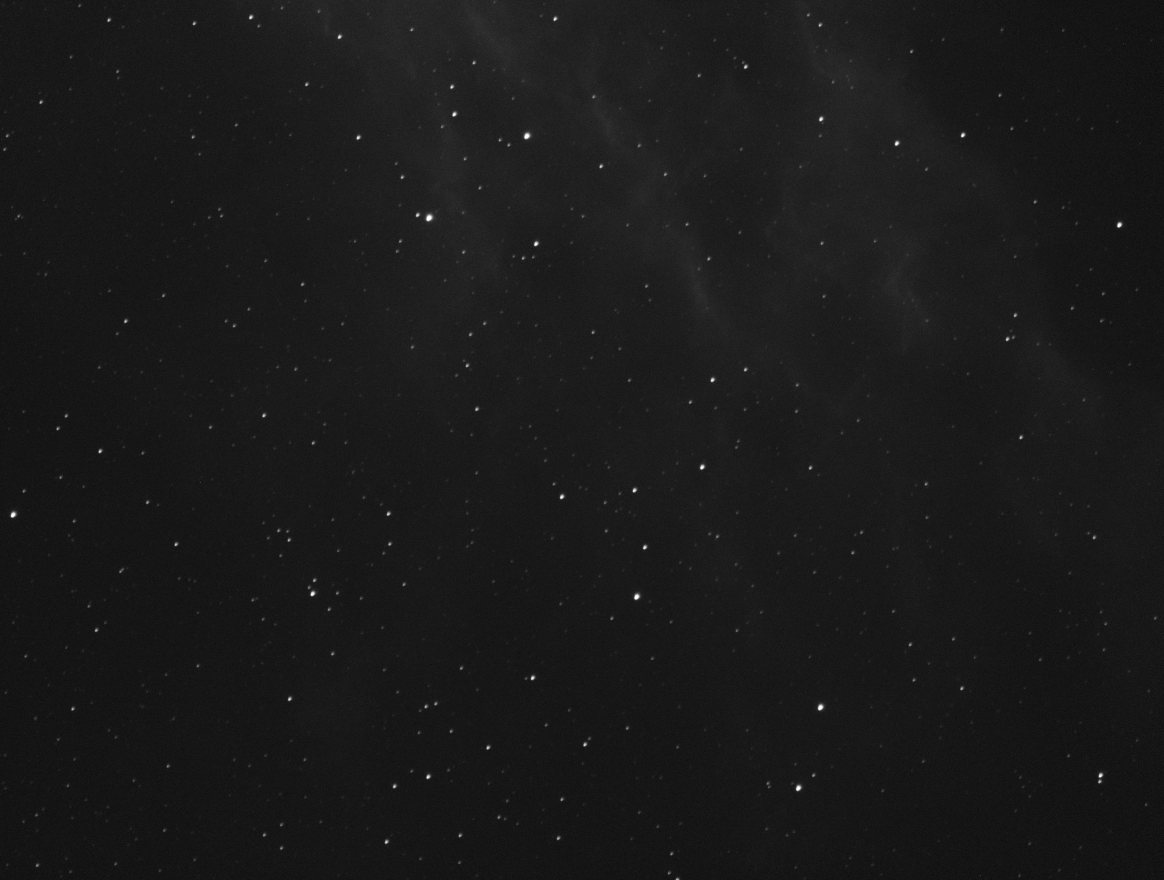
A single calibrated light, stretched for viewing (step 5 explains how), is noisy and has few stars, as a five-minute frame at this focal length does:
2. Register
valerian register calibrated/ -o registered
read 5 frames in 56.2ms
compute: CPU (the GPU is slower for this command; --backend gpu forces it)
reference candidate frame 0: 4 of 4 other frames register
reference: frame 0 (FWHM 8.06 px)
   #  frame                         stars   FWHM  ellip      sky    noise   flux x rms px weight  reject  status
   0  2023-01-25_20-43-49_Ha_-10.0   1000   8.06  0.239     77.7    59.28   1.0000  0.000   0.00   0.00%  reference
   1  2023-01-25_20-49-13_Ha_-10.0   1000   8.22  0.222     77.8    59.31   1.0000  0.438   0.00   0.00%  stacked
...
registered 5 of 5 frames to frame 0; wrote them to registered
register finds the stars in every frame (up to a thousand), chooses the reference (the
sharpest frame that the others register to, here frame 0 with a FWHM of 8.06 pixels)
and fits a transform from each frame to it by matching triangles of stars. rms px is
how far the matched stars are from where the fit puts them: under half a pixel for every
frame here. Each frame is resampled onto the reference grid and written with _reg added
to its name. A frame that cannot be registered (a different field, clouds, too few stars)
is reported as skipped with the reason and left out.
You rarely need register on its own, because stack does it. It is there if you want
registered frames for another tool, or to look at them. See
How registration works.
3. Stack
valerian stack calibrated/ -o stack.fits \
    --report report.txt --coverage coverage.fits
read 5 frames in 59.7ms
compute: GPU: NVIDIA A100 80GB PCIe (Vulkan, DiscreteGpu)
reference candidate frame 0: 4 of 4 other frames register
reference: frame 0 (FWHM 8.06 px)
frame 1: registered, 800 stars matched, rms 0.438 px, shift (7.08, 11.98), rotation -0.0009 deg, flux x0.9974
...
combining 5 frames with Winsorised { low: 3.0, high: 3.0 }, weights NoiseFwhm on GPU: NVIDIA A100 80GB PCIe (Vulkan, DiscreteGpu)
   #  frame                         stars   FWHM  ellip      sky    noise   flux x rms px weight  reject  status
   0  2023-01-25_20-43-49_Ha_-10.0   1000   8.06  0.239     77.7    59.28   1.0000  0.000   1.03   0.66%  reference
   1  2023-01-25_20-49-13_Ha_-10.0   1000   8.22  0.222     77.8    59.31   0.9974  0.438   1.00   0.56%  stacked
   2  2023-01-25_20-54-39_Ha_-10.0   1000   8.58  0.182     75.6    59.02   0.9854  0.448   0.95   0.34%  stacked
   3  2023-01-25_20-59-52_Ha_-10.0   1000   8.09  0.223     75.7    58.78   1.0033  0.436   1.04   0.46%  stacked
   4  2023-01-25_21-05-17_Ha_-10.0   1000   8.27  0.203     74.7    58.92   0.9987  0.442   0.99   0.20%  stacked
5 of 5 frames stacked with Winsorised { low: 3.0, high: 3.0 }, reference frame 0 (2023-01-25_20-43-49_Ha_-10.00_300.00s_0000_cal.fits), 1.6s
wrote stack.fits
wrote coverage.fits
wrote report.txt
The same registration, then the frames are matched in level (sky, flux x), weighted
by noise and star width (weight: the sharper, quieter frames count for more) and combined
with per-pixel outlier rejection (reject is the share of each frame's samples thrown out
as cosmic rays, satellites and the edges of a shifted frame). On a machine with a graphics
card stack uses it by default (compute: GPU: ...); --backend cpu forces the CPU and
the result is the same to within the GPU parity tests' tolerances (see
The GPU kernels). --report keeps the table in a text file and --coverage
writes how many frames contributed to each pixel. See How stacking works.
Look at what you have:
valerian info stack.fits --stats
stack.fits
  size: 4656 x 3520 pixels, 1 plane
  OBJECT    California Nebula Pa
  IMAGETYP  Master Light
  FILTER    Ha
  EXPTIME   300
  EXPOSURE  300
  CCD-TEMP  -10
  SET-TEMP  -10
  GAIN      139
  OFFSET    21
  XBINNING  1
  DATE-OBS  2023-01-25T20:43:49.698
  INSTRUME  ZWO ASI1600MM Pro
  TELESCOP  Starwatcher Esprit 1
  FOCALLEN  840
  NCOMBINE  5
  EXPTOTAL  1500
  plane 0: min -615.6, sky 79.8, noise 39.30, max 68116.2 ADU
  stars: 1000 (median FWHM 8.28 px, ellipticity 0.206)
Five five-minute lights became EXPTOTAL 1500 seconds. The stack is linear, so it looks
almost black until it is stretched.
4. Remove the sky gradient
valerian background stack.fits -o flat.fits --degree 1 --save-model glow.fits
plane 0: 889 samples of 975 tiles (110 px), 16.0% masked, residual rms 13.05, gradient removed 29.6
wrote flat.fits
wrote the background model glow.fits
The image is cut into 110 pixel tiles, each gives the median of its clear pixels, and a
plane (--degree 1) is fitted to the 889 tiles that hold only sky, rejecting the 86 that
stars or the nebula lift. The plane is subtracted and the mean level put back, so the glow
goes and the sky stays where it was. glow.fits is the fitted glow, to look at. This
target fills much of the frame, so a plane, the safest model, is the right choice; see
How background extraction works for polynomials and splines.
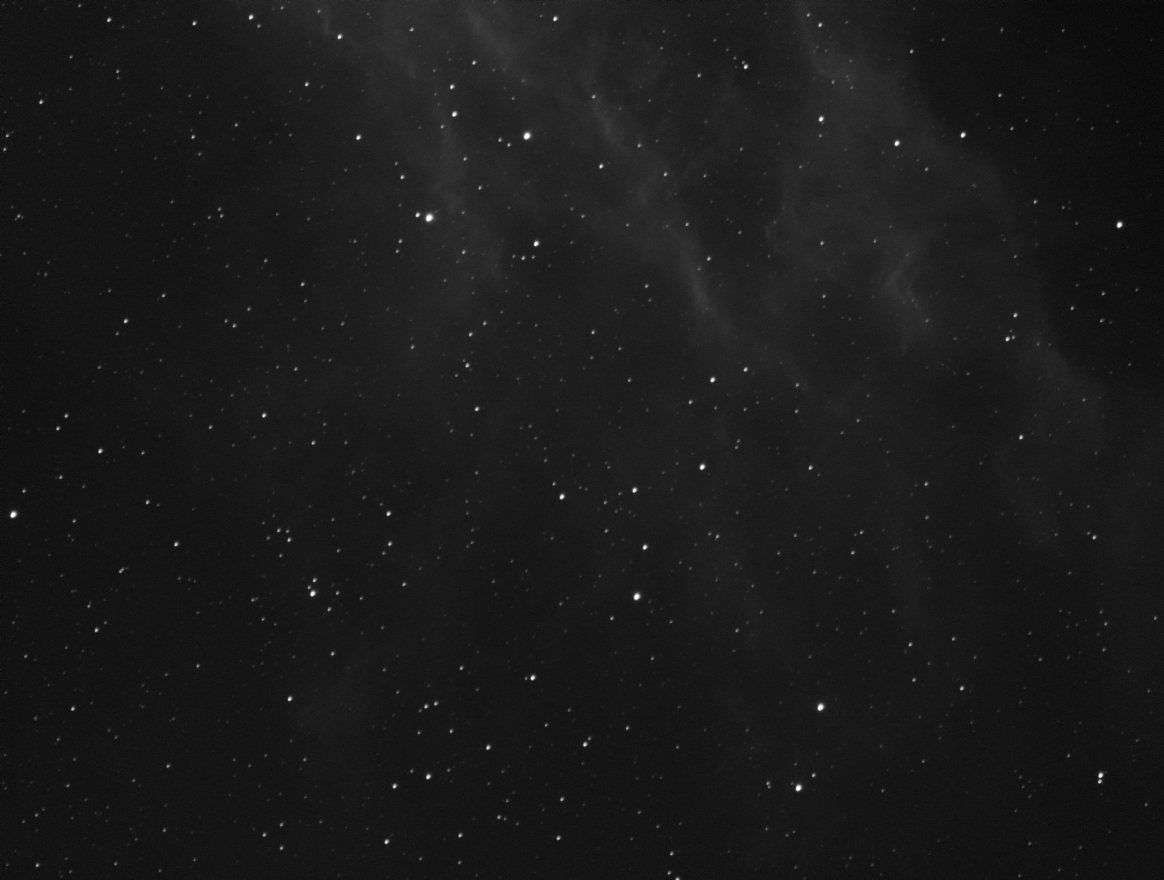
5. Look at it: stretch
valerian stretch flat.fits -o stretched.fits --preview stretched.png
black -24.1475, white 22800.3184, Mtf { midtone: 0.04070693853135364 }
plane 0: median 82.9631 -> 0.1000
wrote stretched.fits
wrote preview stretched.png
The black point goes just below the sky, the white point at the 99.995th percentile, and a
midtone transfer function is solved to put the sky at 0.10. --preview writes the result as
a PNG you can open anywhere (add --preview-size for a different size) without committing to
the stretch. The FITS file records the stretch in its header, so
valerian stretch stretched.fits --invert -o linear.fits undoes it. For the curves, see
How stretching works.
6. Remove the stars
valerian starless flat.fits -o starless.fits --stars-out stars.fits \
    --preview starless.png
2224 stars found, 13.04 % of the pixels filled
wrote starless.fits
wrote stars.fits
wrote preview starless.png
Each star gets a mask disc sized from its brightness and width, and the masked pixels are
filled by diffusion from their surroundings with noise of the local level added. --stars-out
keeps what was taken out (original minus starless), which can be added back later, and
--strength 0.5 would reduce the stars by half instead of removing them. The preview puts the
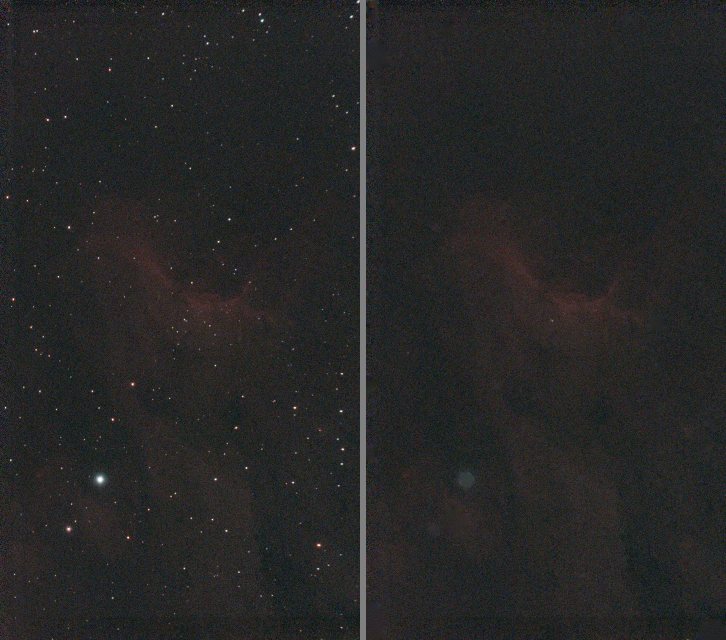
original beside the starless image, both on the same stretch:
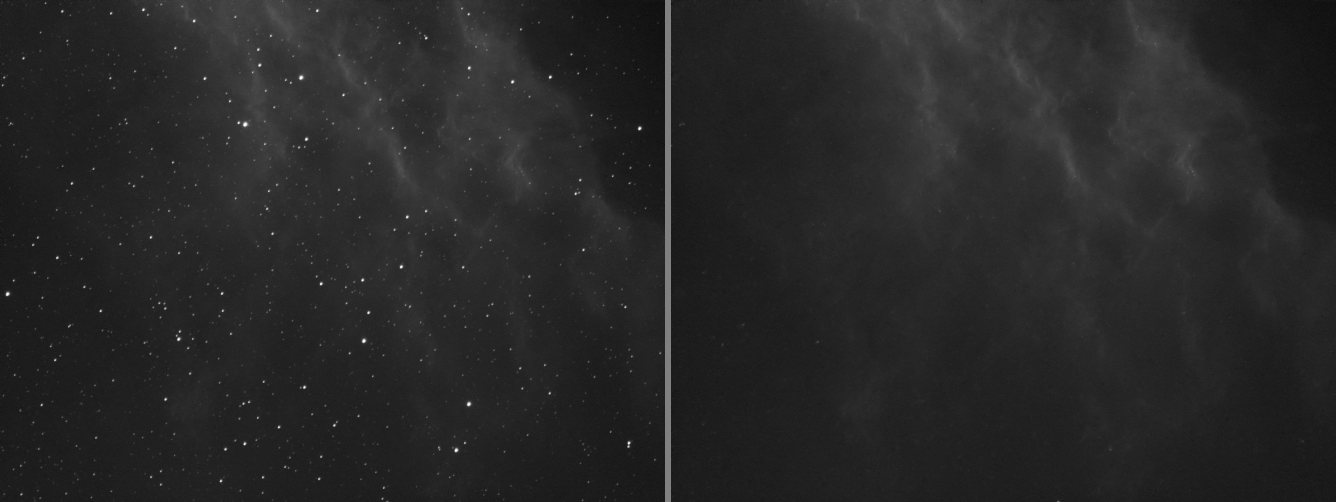
It does not recreate texture a bright star hides, and diffraction spikes and stars below the detection limit stay. See How star removal works.
Part 2: one-shot colour, no calibration frames
A Seestar S50 writes raw mosaics. With no darks or flats there is nothing to calibrate against, so go straight to the stack: Valerian demosaics raw Bayer frames itself.
7. Stack sixty frames
valerian stack lights/ -o stack.fits --report report.txt
read 60 frames in 82.6ms
compute: GPU: NVIDIA A100 80GB PCIe (Vulkan, DiscreteGpu)
reference candidate frame 47: 59 of 59 other frames register
reference: frame 47 (FWHM 2.16 px)
...
combining 60 frames with LinearFit { low: 5.0, high: 2.5 }, weights NoiseFwhm on GPU: NVIDIA A100 80GB PCIe (Vulkan, DiscreteGpu)
GPU: 3 calls ran on the device
   #  frame                         stars   FWHM  ellip      sky    noise   flux x rms px weight  reject  status
   0  Light_IC 5070_10.0s_LP_20260    199   2.65  0.300    662.0    54.61   0.9541  0.351   1.18   0.83%  stacked
   1  Light_IC 5070_10.0s_LP_20260    194   2.67  0.313    663.5    54.78   0.9673  0.323   1.12   0.87%  stacked
...
  59  Light_IC 5070_10.0s_LP_20260    117   3.84  0.514    640.0    52.05   1.4967  0.484   0.25   6.43%  stacked
60 of 60 frames stacked with LinearFit { low: 5.0, high: 2.5 }, reference frame 47 (Light_IC 5070_10.0s_LP_20260728-224223.fit), 9.4s
wrote stack.fits
wrote report.txt
With sixty frames Valerian chose linear-fit rejection (--rejection auto: Winsorised below
fifteen frames, sigma clipping to thirty, linear fit above). The weights run from about 2 for the
sharpest, quietest frames down to 0.14 for frame 23, which had lost half its light (it needed a flux
factor of 2.05 to match the reference), and 0.25 for frame 59, whose stars are 3.84 pixels wide and
elongated (ellipticity 0.51): a frame that tracked badly or was dimmed by cloud barely counts. Frame 47,
with the sharpest stars (2.16 pixels), is the reference.
valerian info stack.fits --stats
stack.fits
  size: 1080 x 1920 pixels, 3 planes
  OBJECT    IC 5070
  IMAGETYP  Master Light
  FILTER    LP
  EXPTIME   10
  EXPOSURE  10
  CCD-TEMP  29.125
  GAIN      80
  XBINNING  1
  DATE-OBS  2026-07-28T21:41:58.801919
  INSTRUME  Seestar S50
  TELESCOP  S50_64dbf865
  FOCALLEN  250
  NCOMBINE  60
  EXPTOTAL  600
  plane 0: min 521.4, sky 610.7, noise 12.49, max 74630.9 ADU
  stars: 518 (median FWHM 2.57 px, ellipticity 0.165)
Three planes now: red, green and blue. The header kept the pointing (RA and DEC) and the
optics, which the plate solver will use.
8. Remove the gradient
valerian background stack.fits -o flat.fits --degree 2 --save-model glow.fits
plane 0: 1150 samples of 1258 tiles (33 px), 13.0% masked, residual rms 1.66, gradient removed 15.4
plane 1: 1173 samples of 1245 tiles (33 px), 11.7% masked, residual rms 0.65, gradient removed 8.2
plane 2: 1433 samples of 1470 tiles (33 px), 9.9% masked, residual rms 0.96, gradient removed 9.8
wrote flat.fits
wrote the background model glow.fits
Colour planes are fitted one by one. A light-polluted site has a different glow in each colour, so this is where much of the colour cast goes.
9. Plate solve
Solving needs the star catalogue, a data file next to the program in a release (see
Plate solving). From a source build, point
VALERIAN_CATALOGUE at the one in the repository:
export VALERIAN_CATALOGUE=crates/valerian-core/data/gaia-dr3-g11.vcat
valerian solve flat.fits -o solved.fits
looking within 1.00 deg of RA 313.0583 Dec +44.5044, scale 2.03 to 2.75 arcsec/pixel
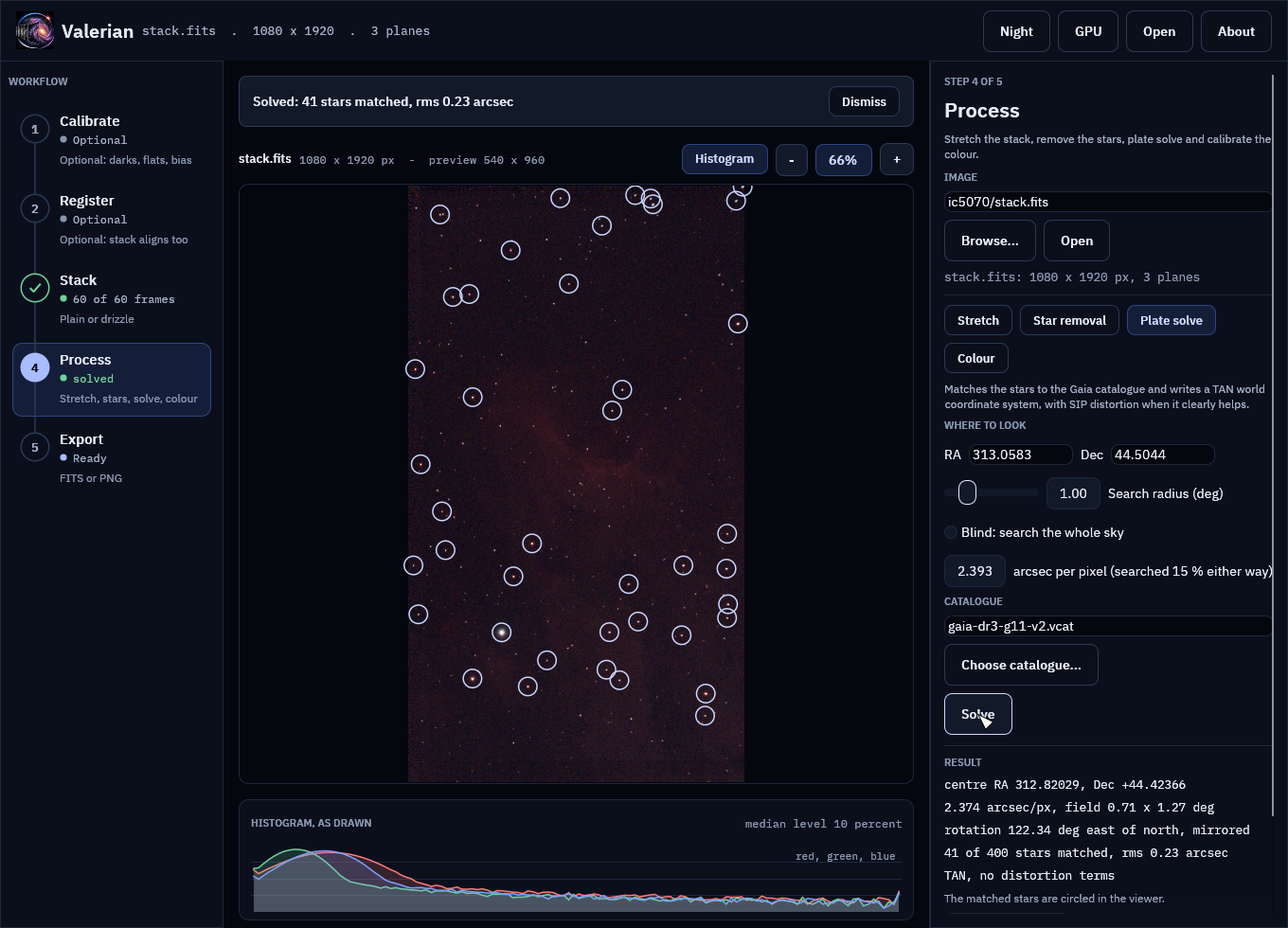
solved: centre RA 20h51m16.9s Dec +44d25m25.2s (312.82029, +44.42366 deg)
scale 2.374 arcsec/pixel, field 0.71 x 1.27 deg, rotation 122.34 deg east of north, mirrored
41 of 400 detected stars matched, rms 0.23 arcsec (0.10 px), plain TAN
wrote solved.fits
The position came from the header's RA and DEC, and the pixel scale from FOCALLEN and
XPIXSZ (2.9 micron pixels at 250 mm is 2.39 arcseconds per pixel, searched within 15 per cent either
way). 41 stars agree with the Gaia catalogue to a tenth of a pixel. solved.fits is a copy of the
image with the world coordinate system in its header; the input is never changed. With no position at all
--scale or --scale-range and --blind search the whole sky. See
How plate solving works.
10. Calibrate the colour
valerian photocal solved.fits -o calibrated.fits --stars-out stars.csv
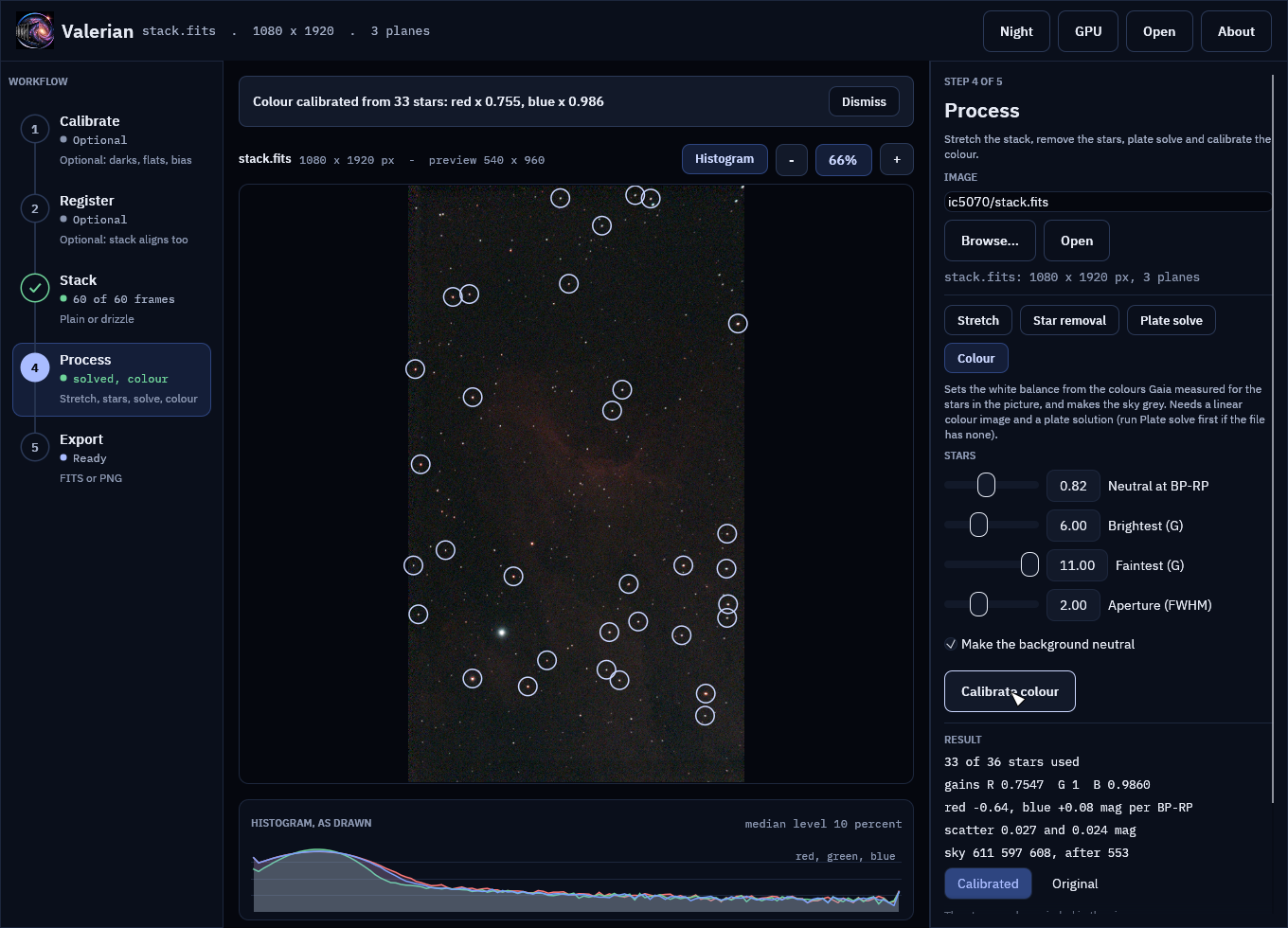
36 Gaia stars measured, 33 used; aperture radius 5.1 px; neutral at BP-RP 0.82
  red against green: slope -0.635 mag per BP-RP, scatter 0.027 mag, gain 0.7547 +/- 0.0032
 blue against green: slope +0.080 mag per BP-RP, scatter 0.024 mag, gain 0.9860 +/- 0.0037
sky before 610.76 597.29 608.32, after 552.68 552.68 552.68 (offsets -91.76 44.61 47.15)
wrote the star table stars.csv
wrote calibrated.fits
The stars of the plate solution are matched to Gaia stars with a known colour (BP-RP), each is
measured through one aperture in red, green and blue, and a line of instrumental colour against
true colour is fitted. The gains make a star like the Sun (BP-RP 0.82) neutral: the red channel is
scaled by 0.7547 and the blue by 0.9860, with green left alone so the brightness stays. The
three planes' sky is then brought to one level, so the background is neutral grey. The gains
and offsets are written to the header as PCCGAINR, PCCGAING, PCCGAINB and the PCCOFF
cards. Do this on a linear image after background extraction and before stretching. See
How colour calibration works.
11. Stretch and remove the stars
valerian stretch calibrated.fits -o stretched.fits --preview stretched.png
valerian starless calibrated.fits -o starless.fits --preview starless.png
black 532.4390, white 5099.4653, Mtf { midtone: 0.0385596760748138 }
plane 0: median 552.7506 -> 0.1002
plane 1: median 552.7175 -> 0.1001
plane 2: median 552.7233 -> 0.1001
wrote stretched.fits
wrote preview stretched.png
684 stars found, 5.62 % of the pixels filled
wrote starless.fits
wrote preview starless.png
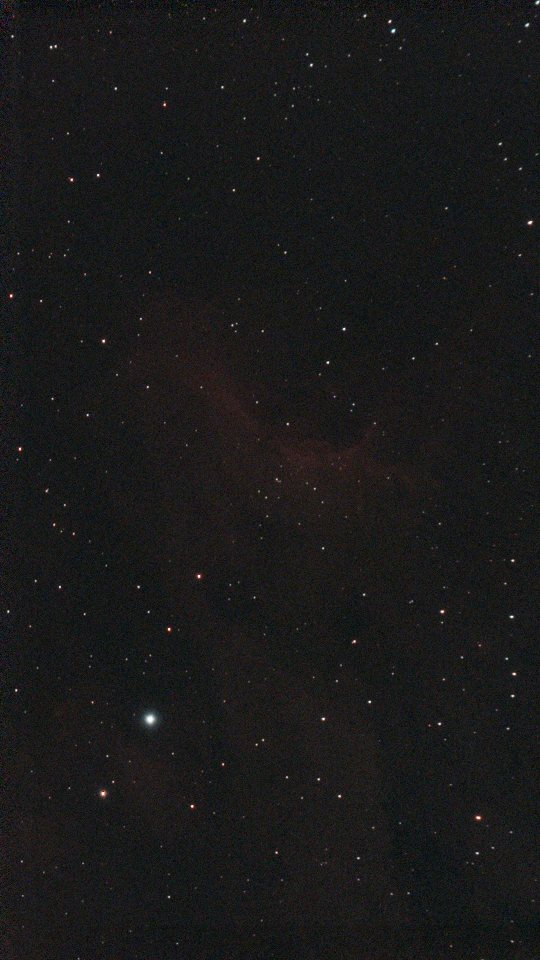
The three planes share one stretch, so the colour balance photocal set is kept and the sky comes out at 0.100 in all three. The sixty-frame stack, plate solved, colour calibrated and stretched:
And with the stars removed:
12. Drizzle
The Seestar's frames are dithered, its stars are only about 2.5 pixels wide and a one-shot-colour
sensor samples red and blue at every second pixel: the case drizzle is for. Instead of a plain stack, give drizzle the same
frames, as raw mosaics (it drops each pixel into its own colour plane without interpolating):
valerian drizzle lights/ -o drizzled.fits --scale 2 --pixfrac 0.6 \
    --report drizzle-report.txt
read 60 frames in 88.3ms
registering through demosaiced copies of the mosaics
reference candidate frame 47: 59 of 59 other frames register
reference: frame 47 (FWHM 2.16 px)
drizzling 60 frames onto 2160 x 3840 (scale 2, pixfrac 0.6), raw Grbg mosaics dropped without interpolation
second pass: rejecting input pixels more than 4 sigma from the first result
...
60 of 60 frames drizzled to 2160 x 3840 (scale 2, pixfrac 0.6), reference frame 47 (Light_IC 5070_10.0s_LP_20260728-224223.fit), 0.28 % of the input samples rejected, 0.015 % of the output without data, 9.4s
wrote drizzled.fits
wrote drizzle-report.txt
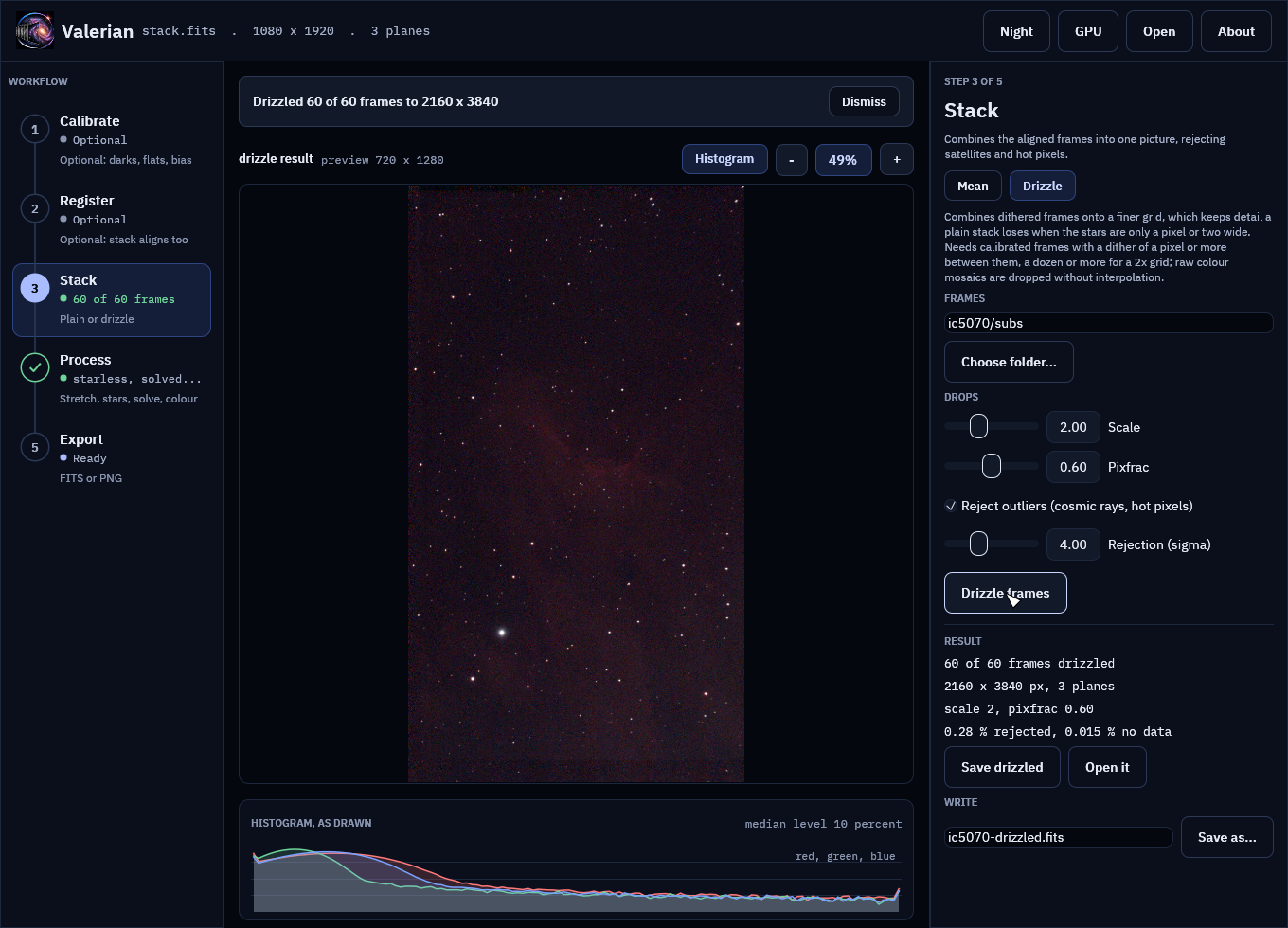
The result is twice as wide and as tall (2160 by 3840), with 0.015 per cent of the output pixels
no drop reached. It is not colour calibrated yet: solve it (the drizzle removes the WCS) and run
photocal, as in steps 9 and 10. Stretched on its own, it looks like this:
valerian stretch drizzled.fits -o drizzled-stretched.fits --preview drizzled.png
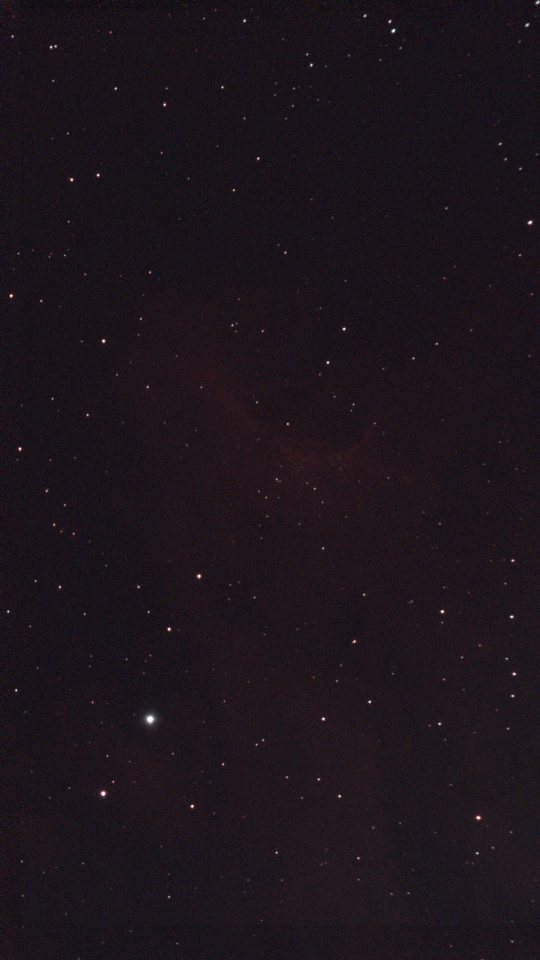
The picture here is shrunk to fit a web page, which hides the detail: open drizzled.fits at full
size next to stack.fits to compare. How much resolution drizzle gains is measured in
How drizzle works, and the nightly Python-parity job in
Building and testing checks it against an independent
measurement. It needs a dither of a pixel or more between frames and a dozen or more of them; with fewer, use a larger
--pixfrac or a smaller --scale.
The same steps in the desktop app
The desktop app (valerian-gui) has every step of this page on its workflow rail:
Calibrate, Register, Stack, Process (Stretch, Star removal, Plate solve and Colour) and
Export, with Drizzle beside Stack. The screenshots below are the real window working on the
frames of this page, drawn by the GUI's own tests (see
Building and testing). Background
extraction (step 4) is on the command line for now.
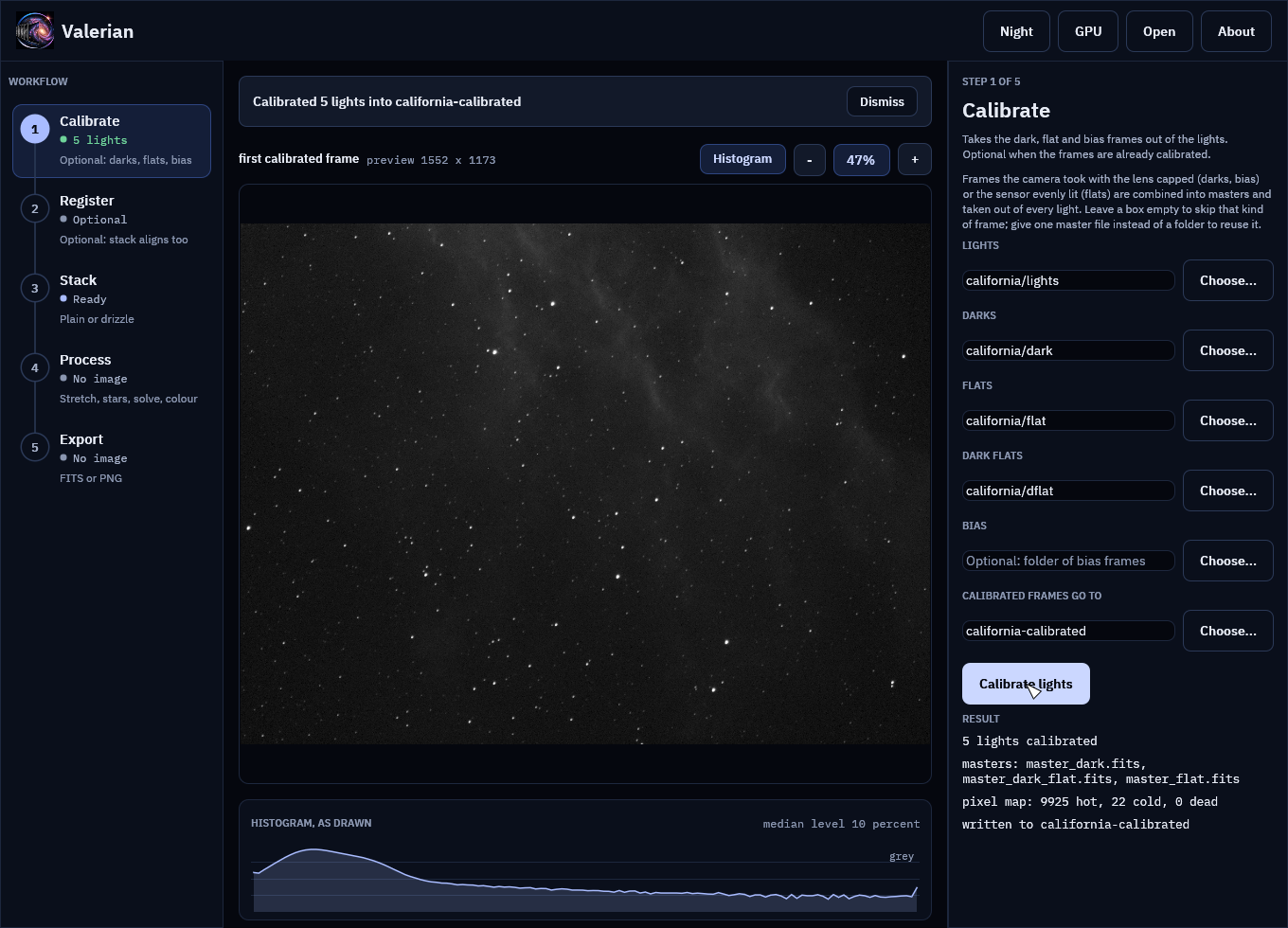
Part 1 in the window: name the lights, darks, flats and dark flats and press Calibrate lights. The viewer shows the first calibrated frame, and the panel says what was made.
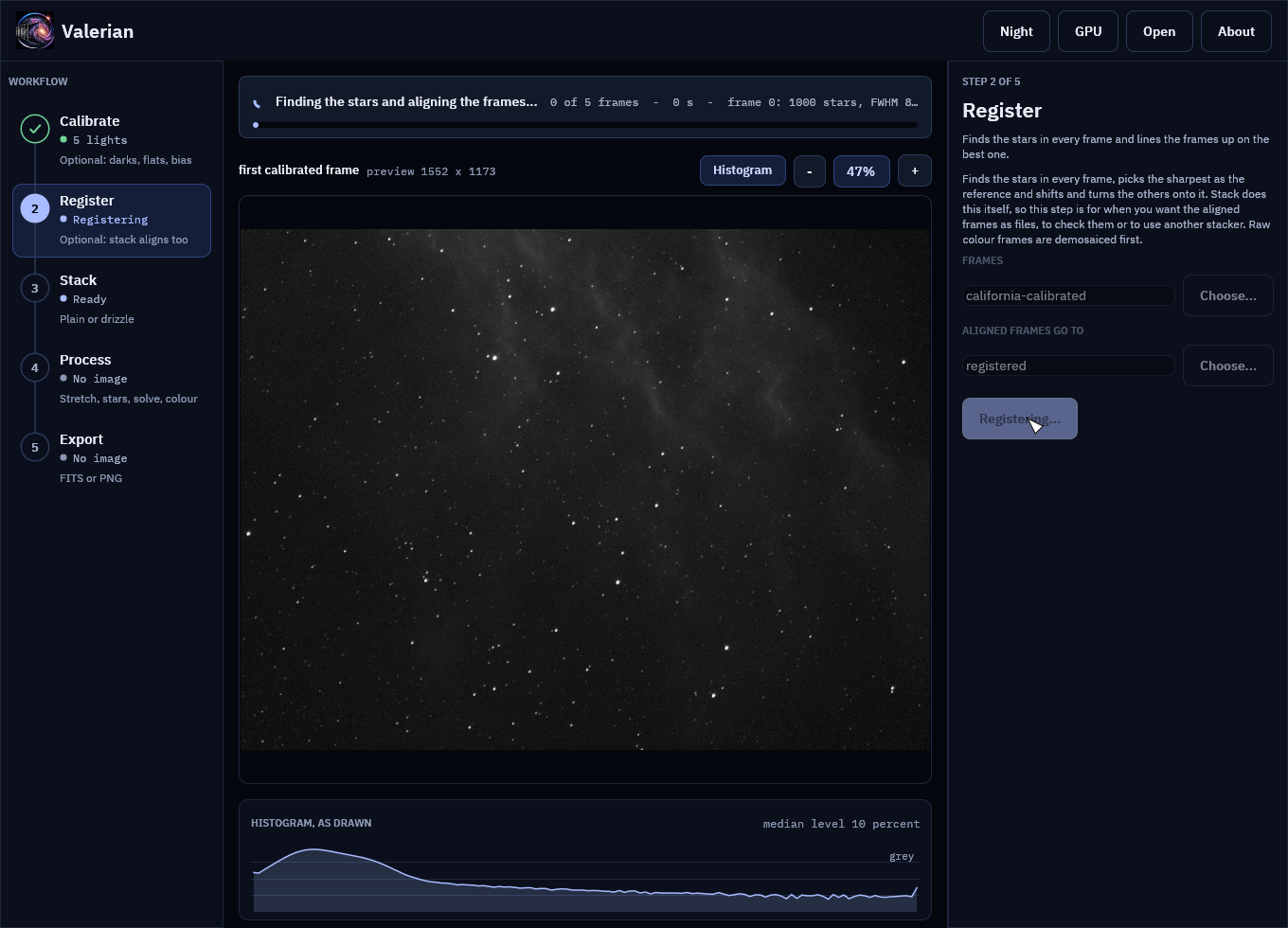
Register frames finds the stars and aligns the frames; the notice above the picture shows the frame it is on, with its star count and seeing, while it works.
Part 2 in the window: Stack frames on the folder of sixty raw Seestar frames registers, combines and opens the stack, ready for the Process step.
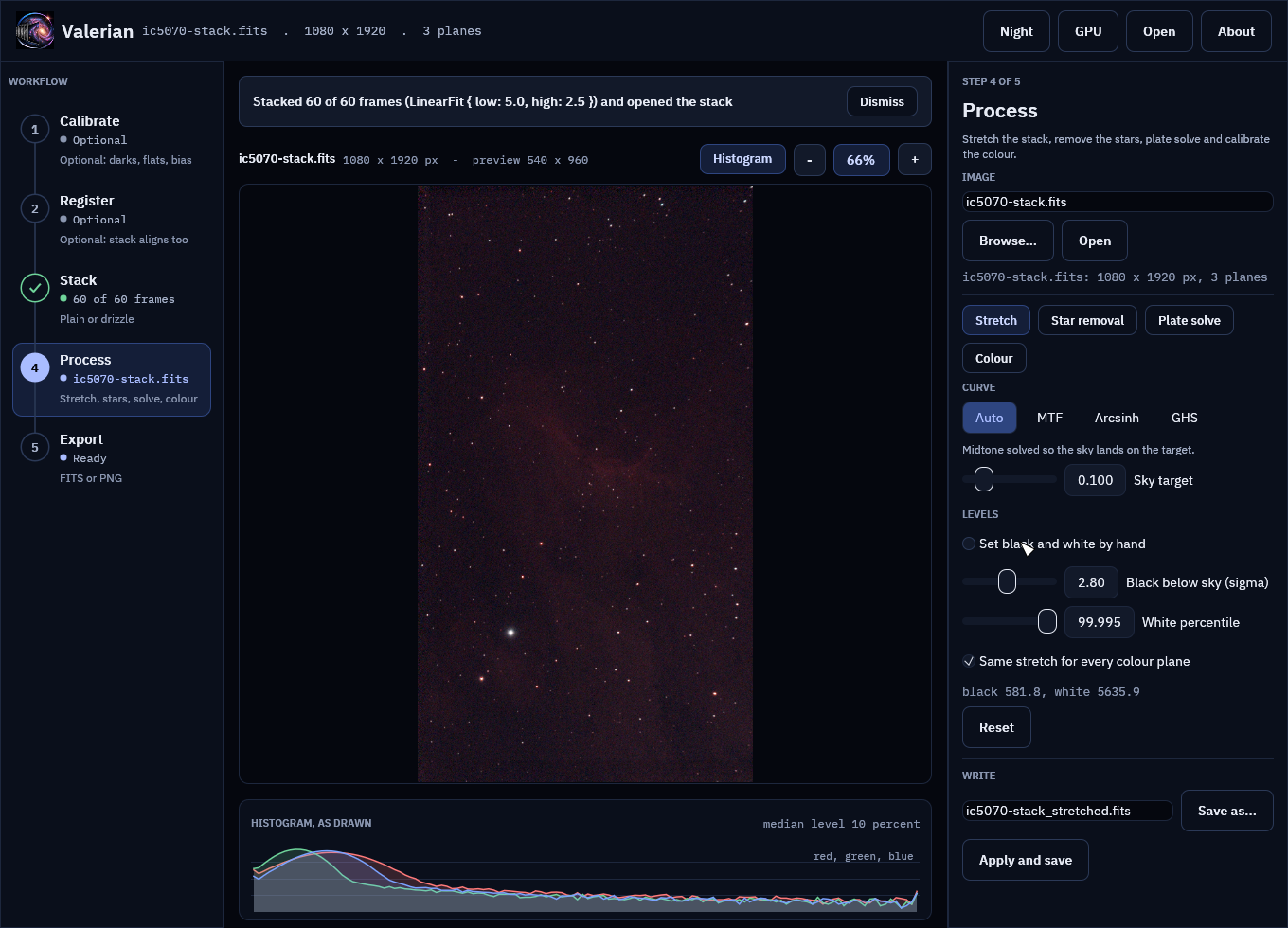
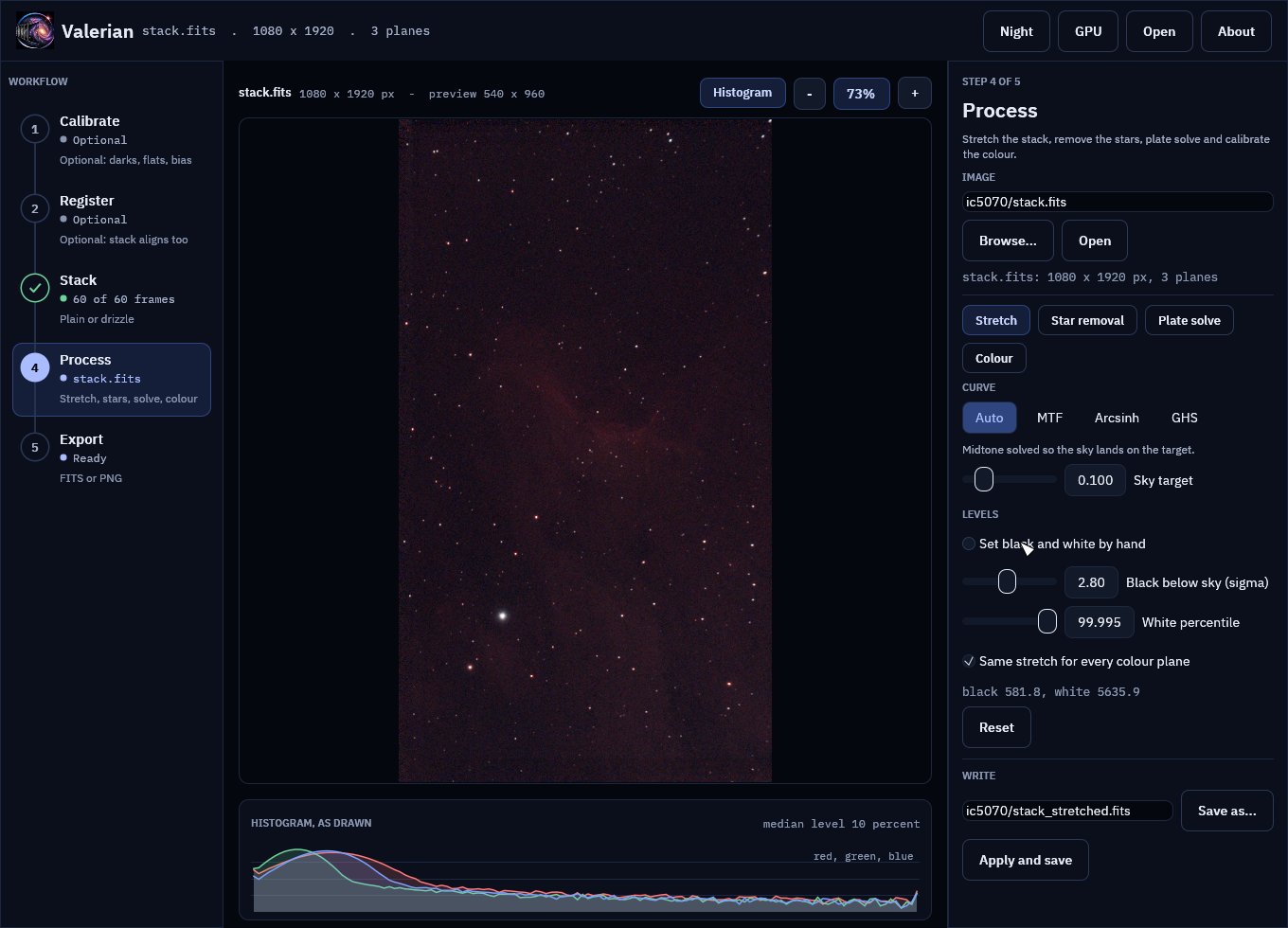
The tools of the Process step work on that stack. Stretch, with the histogram of what is drawn under the picture:
Star removal:
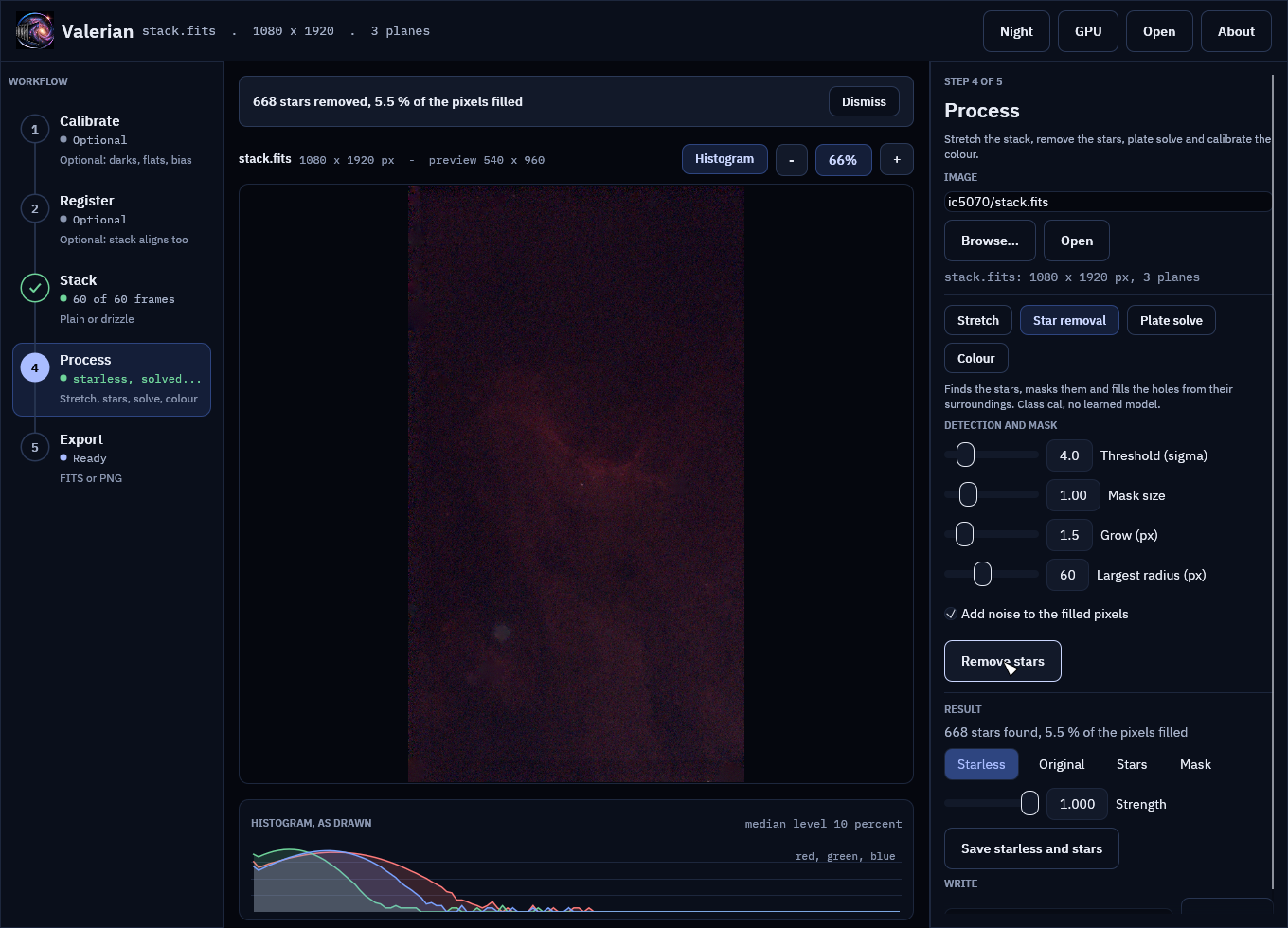
Plate solve, with the matched stars circled:
Colour, calibrated against Gaia star colours:
Drizzle, in the Stack step, on the same sixty frames:
The desktop app describes every step, the notices, the view and the file dialogs.
Without a telescope
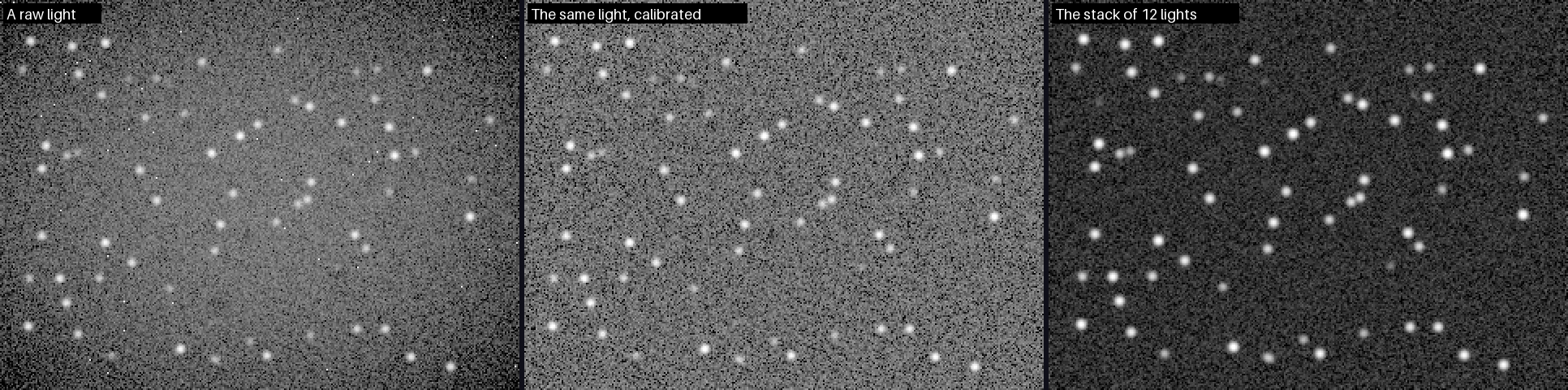
If you have no data yet, the repository has a small script that writes a made-up session: a star field that drifts a few pixels from frame to frame, with a bias level, dark current, hot pixels, vignetting, dust, cosmic rays and one frame of poor seeing. It needs only the Python standard library, and the same seed always gives the same files:
python3 scripts/make_synthetic_session.py demo
valerian calibrate demo/lights --dark demo/darks --flat demo/flats --dark-flat demo/dark-flats \
    -o demo/calibrated --masters demo/masters
valerian stack demo/calibrated -o demo/stack.fits --report demo/report.txt
wrote 12 lights, 8 darks, 8 flats and 8 dark flats to demo/
It is a way to try the tools, not a picture of the sky. The poor-seeing frame (frame 7, FWHM 5.9 pixels against 3.4) gets a weight of 0.33 where the sharp frames get 1.1 to 1.2, which is what the weights are for.
Where next
The quick start is the short version of this page, the CLI reference lists every option, and each tool has a page that explains the method and its limits.